Thursday, February 6, 2014

Do you have plans in place for Microsoft® XP's ‘End of Life’ ?


Do you have plans in place for Microsoft® XP's ‘End of Life’ coming up on April 8th? It’s approaching quickly, and will be here before we know it.

Running XP beyond the end of life cutoff date means that Microsoft will no longer offer support. Critical updates and security patches will not be released, leaving the operating system at risk and vulnerable. Hackers will be standing by to attack as soon as it’s retired. 

Can you afford to put your business at risk?

There are alternatives to updating and managing the operating software available and likely will reduce your IT operating expense. 

LKC is here to help with the process and provide alternatives. How can we help you? 


Tuesday, January 28, 2014

AT&T blames U-verse Internet outage on 'web hosting service issue'

FierceCable
January 27, 2014 | By Steve Donohue

AT&T (NYSE: T) was hit with a major outage impacting its U-verse service, sources reported Monday.

The service provider said that while U-verse broadband Internet customers in several states lost service, its U-verse TV and voice products were not impacted. 

"A limited number of AT&T customers across multiple states may have experienced a disruption with U-verse high speed Internet service due to a third-party web hosting service issue," an AT&T spokesperson said in a statement sent to FierceCable. "Technicians worked to quickly resolve the issue, and service is currently running normally." 

In January 2013, AT&T blamed "an issue with a server that supports U-verse" for causing a major outage of its broadband service.


Thursday, January 23, 2014

CenturyLink extends cloud services to SMB customers

FierceTelecom

January 22, 2014 | By Sean Buckley


CenturyLink (NYSE: CTL) is bringing its cloud services down to small-to-medium sized businesses (SMBs) with the debut of its Managed Office service bundle. The offering is intended to provide a higher level of customer service to SMBs, like what is available to larger enterprise customers.

Using a mix of network, hosted VoIP and cloud capabilities, customers that sign up for the Managed Office suite will be able to get a host of IP services and custom support.

In addition to Managed network and Hosted VoIP, CenturyLink will offer Managed CPE, Hosted apps and cloud storage, and security software. These services will be complemented by Managed install and training, one-stop customer support and scalable, per-seat pricing.

Creating a suite of cloud services that are specifically packaged for the needs of the SMB makes sense. This segment typically lacks the capital to support a large IT staff that can implement complex communications solutions.

The new SMB service package comes at a time when CenturyLink is positioning itself as a full service IT and managed services provider for any size business customer. Earlier this week, the telco rebranded its Savvis data hosting subsidiary as CenturyLink Technology Solutions as a way to better align the business unit and parent company.

CenturyLink can also apply the Managed Office bundle to both its existing SMB customer base and previous customers that may have churned to another operator.


Tuesday, January 21, 2014

Google buys Nest Labs for $3.2B to get foothold in Internet of Things

FierceWireless
January 14, 2014 | By Phil Goldstein

Google (NASDAQ:GOOG) paid $3.2 billion to acquire Nest Labs, a maker of smart thermostats, smoke alarms and other home gadgets, grabbing a foothold in the smart home and Internet of Things markets. The size of the acquisition, while not on the same scale as Google's $12.4 billion deal for Motorola Mobility, indicates Google's desire to establish itself in a market that may be one of the next frontiers of computing and Internet access.
Net was launched in 2011 by Apple (NASDAQ:AAPL) iPod creator Tony Fadell. According to Re/code, which cited unnamed sources familiar with the matter, Google was the only serious bidder for Nest and Apple was not in the mix.
"Nest's founders, Tony Fadell and Matt Rogers, have built a tremendous team that we are excited to welcome into the Google family," Google CEO Larry page said in a statement. "They're already delivering amazing products you can buy right now--thermostats that save energy and smoke/CO alarms that can help keep your family safe. We are excited to bring great experiences to more homes in more countries and fulfill their dreams!"

The Nest Learning Thermostat is perhaps the company's best-known product, and has been featured in smart home demos by Verizon Wireless (NYSE:VZ) and other carriers. In a company blog post, Fadell noted that Nest has partnerships with some of the largest energy companies in the country, has a team of 25,000 certified professionals who help install Nest in the U.S. and Canada, and the company has more than 300 employees spread across three countries.

"So if things are going so well, why did we decide to partner with Google?" he wrote. "Google will help us fully realize our vision of the conscious home and allow us to change the world faster than we ever could if we continued to go it alone. We've had great momentum, but this is a rocket ship."

Google Ventures has been one of Nest's backers, and Fadell related how at the 2011 TED Conference, Nest showed Google co-founder Sergey Brin a video and an early model of the Nest Learning Thermostat. "He instantly got what we were doing and so did the rest of the Google team when we showed them," Fadell recounted.

Analysts said the deal pointed to how important the Industrial Internet--one aspect of the Internet of Things based around home appliances and other goods--will be in the years ahead. "The Industrial Internet may not be as sexy as the latest smart watch, but there's huge amount of money to make from devices, applications, connectivity and services," MachNation analyst Steve Hilton said. "These solutions can bring the communications to billions of electromechanical devices in our world."

"The Nest acquisition by Google is yet another validation point that the Internet of Things (IOT) sector has graduated far beyond its startup phase," Gilad Meiri, IoT industry expert and CEO of Neura, said in a statement. "Google has made an art out of deeply understanding how people interact with their virtual world, the Web, and in so doing has been able to monetize that understanding in wildly successful ways. This acquisition is the first of what we see as potentially many next steps by Google and others to further understand the vast amounts of data representing how people interact with their physical world."

Monday, January 6, 2014

AT&T's special access proposal faces fire from CompSouth


FierceTelecom

January 6, 2014 | By Sean Buckley

AT&T's (NYSE: T) desire to eliminate pricing discounts on special access contracts that are longer than three years now faces its latest challenge from CompSouth, an association of CLECs serving business customers in the Southeast.

The telco's main argument is related to its goal of switching all of its current wholesale TDM-based special access customers to IP-based services such as Ethernet by 2020.
In its filing with the Tennessee Regulatory Authority (TRA), CompSouth said AT&T has not provided any facts about how it would no longer be able to provide DS1 and DS3 services after it transitions to all-IP. Incumbent telcos use circuit emulation technology that allows TDM-based services to be transported over an IP network.  
"CompSouth submits that there is no factual basis for AT&T's claim that the company will be unable to continue offering DS1 and DS3 services following its alleged transition to an 'all IP' network," the organization wrote in its complaint.

If AT&T eventually gets its way, a wholesale customer's monthly charges could increase by as much as 20 to 30 percent for some services.

CompSouth said that AT&T's proposed "elimination of long-term discounts for DS1 and DS3 services is not necessitated by the transition to IP but by AT&T's desire to increase revenue from the sale of DS1 and DS3 services."

Critics say AT&T's proposal has two implications for businesses that are served by competitive providers. Besides raising service prices, the other reality of AT&T's proposal is that much of the TDM equipment used today won't be replaced for a number of years. And while Ethernet and IP have advantages in terms of speed and flexibility, they are not universally available, nor are the higher speeds appropriate for every business.

Currently, AT&T and fellow RBOC Verizon (NYSE: VZ) own about 80 percent of the special access market.

Competitive providers that purchase wholesale special access services from AT&T and other incumbent telcos got a reprieve in December when the FCC said that it was suspending the telco's plan for five months.


Thursday, January 2, 2014

AT&T sets TDM-to-IP transition trials to focus on challenges, service impact

FierceTelecom
January 2, 2014 | By Sean Buckley

AT&T (NYSE: T) brought proposals to the FCC to begin testing its TDM-to-IP transition and to set a timeline to make these changes throughout its 4,700 wire centers.

During a recent meeting with the FCC's Technology Transition Task Force, the telco said that it would focus on conducting service-based experiments in wiring centers that "represent the challenges it will face with the transition and conduct an extensive review of the services to be impacted as part of this experiment."
The telco added that the tests will represent a mix of both consumer and business services geographies. It will also incorporate reporting capabilities "as a means for keeping the FCC informed about any experiments in progress."  
Out of the three largest telcos, AT&T has been the most vocal proponent of the TDM-to-IP transition, which it plans to complete by 2020.

AT&T previously expressed frustration over a lack of action from the regulator on the transition. New FCC chairman Tom Wheeler proposed that the regulator issue an order on the matter at its upcoming meeting this month.

In tandem with its TDM-to-IP transition, the telco also discussed with the FCC its proposal to eliminate discounts on long-term contracts for TDM-based special access circuits. This proposal has drawn fire from a number of competitive providers, including Sprint (NYSE: S), tw telecom (Nasdaq: TWTC) and Windstream (Nasdaq: WIN), which argue AT&T is abusing its dominant position in the wholesale special access market.

While AT&T maintains that its tariff proposals are "lawful," they are looking at ways to create a "viable path to the TDM-to-IP transition." It proposed a number of modifications that it said would enable wholesale customers to still purchase and maintain DSn (digital signal) services and related pricing closer to the 2020 IP transition deadline.


Wednesday, December 11, 2013

Amazon, Microsoft And The Colocation Challenge


Gregory Ness picture


The Amazon (AMZN) AWS public cloud offering has set the stage for a massive transformation of enterprise IT from being premise-driven (servers, switches, data centers, etc.) to being services driven (APIs, services, consoles, etc.). This transformation promises to produce a new crop of winners and losers.
2014 should be a pivotal year in the emergence of hybrid cloud, as Microsoft (MSFT) and VMware (VMW) enter the cloud space with their own offerings, and compete directly with Amazon for the $1 trillion+ enterprise IT market once protected by moats of complexity, specializations and proprietary hardware. Those moats once protected and sustained dozens of large cap technology companies from legions of emerging companies who simply couldn't achieve critical mass with available resources. Amazon is in the process of destroying those moats.
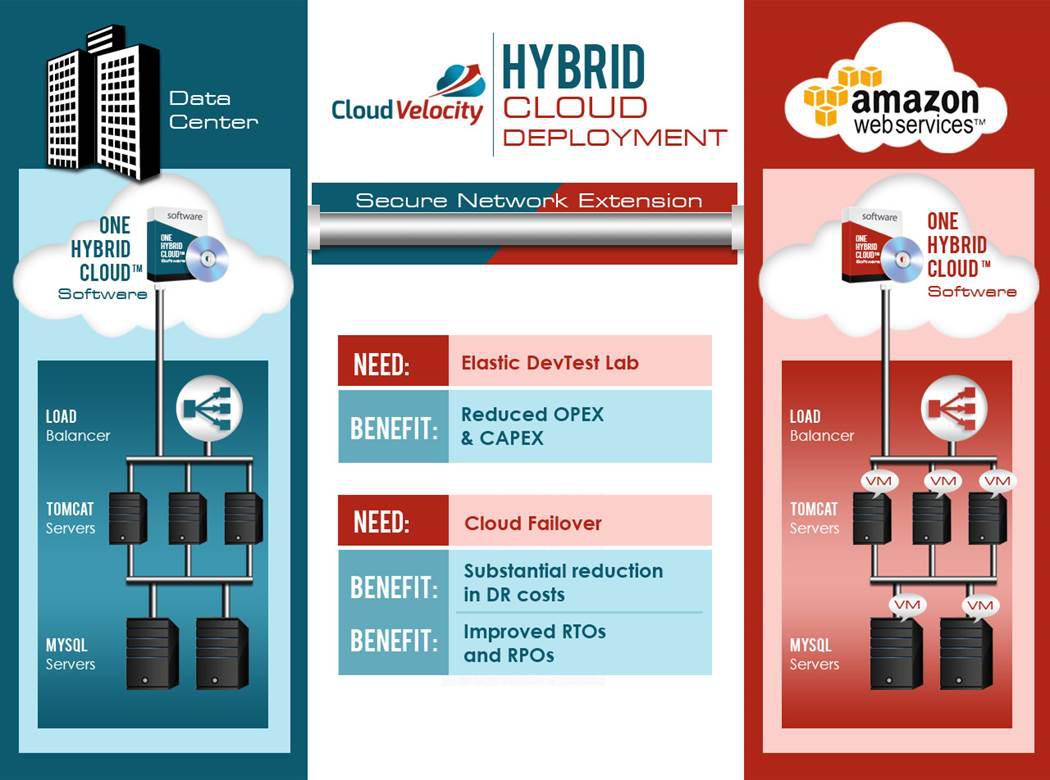
The next trigger should be the evolution of hybrid cloud automation, or the ability for apps and services to easily move from facilities into clouds and ultimately between them. Leveraging the cloud for "pay as you go" disaster recovery and agile DevTest can be faster and more efficient than most comparable legacy approaches locked into a vendor or a facility or even a cobbled collection of legacy facilities. It would accelerate the shift to cloud for enterprise production apps.
The following is a hybrid cloud architectural diagram courtesy of my employer (CloudVelocity):
Hybrid Cloud Architecture, courtesy of CloudVelocity
It is all about agility, protection and efficiency, at levels practically impossible in virtually every firm that has made substantial IT investments over the last few decades. Dedicated, specialized hardware has become the problem rather than the solution, especially when it comes to agility and ongoing operating costs in increasingly complex environments.
Kepes: Agility and Mobility is becoming the New Normal
For reference see this recent Forbes article by Ben Kepes: Do Containers Mark the Death Knell for Virtualization? Ben, a leading cloud blogger and expert, who discusses the tradeoffs between bare metal and virtualized servers for enterprise agility and flexibility, a debate that might have been unthinkable as recent as five years ago. His summary nails the core sentiment.
We're in both a macro paradigm shift and a micro one. The macro one takes us to a world where agility, flexibility, mobility and the cloud are the norms. - Ben Kepes, Forbes, Dec 10, 2013
Indeed, the monetization of complexity that drove the massive creation of market caps in the networking, server and software industries is being replaced by increasingly service-centric products that deliver APIs (application program interfaces) from the cloud. The result of the emergence of services versus racks is heightened agility, protection and efficiency, not to mention the ability of IT teams to focus on new product and service development versus routine maintenance.
IT becomes even more strategic to the business, and more closely aligned with product development and marketing as cloud providers build powerful services that simplify tasks and increase efficiencies.
This is not a subtle shift for an industry once dominated by the massive pools of technical expertise and the manual steps required to simply add a server into a large network. Colocation vendors thrived because they could enable growth and change faster and cheaper than many organizations. Yet that world is changing.
Colocation and the Cloud Transformation
Thus far, Amazon has dominated the IaaS cloud market, per this (and other) recent Seeking Alpha cloud infrastructure market report, based on a Synergy Research report cited in GigaOm.
By Synergy's measure, total IaaS/PaaS revenues for the quarter passed $2.5 billion with IaaS making up 64 percent of the total. Within IaaS alone, AWS accounted for 35 percent of the market; IBM 7 percent; and "everyone else" less than 3 percent each. In PaaS, Salesforce.com-with its Force.com and Heroku soon to be joined by Heroku1-had an 18 percent share; AWS 17 percent; Microsoft 14 percent; Google 13 percent; and everyone else less than 5 percent each.
Beneath the surface of the Amazon-led IT transformation is the murkier story: that is, what happens to all of the business models that came of age in the hardware specialization era, which tied their growth and profits to the once accelerating demands for increasingly powerful and robust hardware and the services required to support increasingly complex and costly data centers?
The Colo Challenge
That takes us to a host of colocation companies that acted as safety valves for the once accelerating gap between operating demands and internal resources. Compare these two observations from the report:
1) Synergy thinks the traditional Web hosting market, which Rackspace remains well-exposed to, and which has been pressured by the IaaS market's rise, only grew 3% Y/Y in Q3.
2) Altogether, Synergy thinks Amazon grew its IaaS/PaaS revenue by 55% Y/Y, outpacing the 46% growth seen by the overall market. Moreover, AWS' IaaS/PaaS revenue is believed to have eclipsed that of Microsoft, Google, IBM, and Salesforce combined.
Amazon could be impacting a sector which has had impressive growth in recent years (as reported in Data Center Knowledge), and was looking at expansion as late as 2011 based on solid research tracking the need for enterprises to outsource operations to third parties:
Roughly 8.75% of total enterprise data center space is currently in colocation. That total will increase to 14.11% by 2015.
Nemertes nailed the trend and naturally thought of the colocation providers as the beneficiaries, as the industry as a whole did. Yet the cloud providers may be capturing a market once owned by the colo players. IaaS revenues in 2011 were hardly measurable in proportion to colocation revenues, and are still perhaps a small portion. Yet the contrast in growth rates has to give pause to the third party data center industry and the ecosystem of vendors who support them. After all, the cloud is the ultimate third party data center.
Two years later, it appears that Amazon and IaaS has impacted the growth in the colo market, starting with small and new apps and now expending to traditional production workloads. I too have been a public cloud protagonist, equally surprised by what has been accomplished in a very short time.
It could get even worse for the colocation industry: along come Microsoft with Azure and VMware with vCloud in 2014 with a new surge of competitive offerings. That means more APIs and services; and fewer hardware-driven headaches for enterprises seeking agility over ownership.
The Two Stage Predicament
Data center development isn't like software where copies are easily made and distributed on demand. Data centers can take years to develop, from start to finish. Could it be possible that, based on 2011 assumptions, colo providers have made investments in data centers based on 2011 sentiments and that some of those facilities have yet to come online? That would mean sizable capital investments made in advance of declining growth rates.
That could set up a two-stage problem, whereby: 1) AWS, Azure and vCloud drive prices lower based on $50B/year in competitive data center infrastructure as a service investments; then 2) excess data center capacity among the traditional players drives them even lower.
The data center colo industry could become like the airline industry, with massive capital investments chasing margins and growth, mostly via consolidation.
Those who simply chased REIT status by focusing on real estate versus services and software and APIs could be rendered irrelevant. What happens to a CAPEX-driven industry when growth rates go from 20% to 3%? We may soon find out.
Consolidation Pressures
I suspect that we will see massive consolidation down to perhaps two dozen players who will earn their positions through superior service, customization, specialization (compliance, security, software, big pipes, etc.), customer loyalty or perhaps scalability and energy efficiency. The generic colocation player without competitive differentiation then becomes a commercial real estate play with assets valued more like climate-controlled warehouses versus information-age factories.
Looking to 2014-2016 it looks like we are gazing at a massive IT transformation and a cyclical rotation of winners and losers on perhaps a scale we haven't seen, yet was predicted in Nick Carr's classic The Big Switch in 2008. Stay tuned.
Additional disclosure: CloudVelocity is an Amazon AWS and Microsoft Azure partner.

Wednesday, December 4, 2013

tw telecom joins CLEC battle against AT&T's special access proposal


December 4, 2013 | By Sean Buckley


tw telecom (Nasdaq: TWTC), one of the largest competitive service providers, followed the route of other CLECs and asked the FCC to deny AT&T's (NYSE: T) proposal to eliminate certain long-term contracts that offer pricing discounts on TDM-based special access circuits it uses to connect business customers to its network. 

As one of the largest competitive service providers, tw telecom has built out a sizeable network that includes 30,000 route miles of fiber. But that network doesn't reach all of its customers.

Like other CLECs such as Windstream (Nasdaq: WIN), tw telecom still has to lease DS1 and DS3 circuits from third party providers like AT&T to accommodate its customers' needs. In many cases, AT&T is the only ILEC they can rent these last mile facilities from. Eliminating long-term contracts will eliminate the contract associated with tw telecom as well.

Mike Rouleau, senior vice president of Business Development and Public Policy for tw telecom, said that if AT&T gets it way they will be forced to raise the prices of the services it provides.

"If these proposed tariff revisions were to take effect, we would have no choice but to seek increases to the retail prices we charge our customers in AT&T's incumbent LEC footprint," he said in a release.
According to industry estimates, AT&T and fellow ILEC Verizon (NYSE: VZ) jointly own about 80 percent of the special access market today.

AT&T argues that it is eliminating long-term contracts on TDM-based circuits because it is going to shut down its TDM network by the year 2020.

tw telecom has asked the FCC to "prohibit AT&T from implementing its proposed price increases by eliminating long-term contracts and pricing plans until the FCC has resolved its ongoing proceedings examining AT&T's market power over special access services--including Ethernet services--and the appropriate transition to IP-based networks."

Although the FCC has been investigating special access reform for over a year, the regulator has yet to issue a decision on AT&T's proposal.


Friday, November 29, 2013

US eyes phase-out of old telephone network

AFP

By Rob Lever


Tech Graveyards


Washington (AFP) - America's plain old telephone network is rapidly being overtaken by new technology, putting US regulators in a quandary over how to manage the final stages of transformation.
Though the timing remains unclear, the impact of change and what it means for roughly 100 million Americans who remain reliant on the dated but still-functional system of copper wires and switching stations is up for debate.
The Federal Communications Commission is working toward drafting rules in January to formalize the IP transition -- switching communications systems to Internet protocol.
And while FCC Chairman Tom Wheeler hails the technological advance, he has also spoken of maintaining the "set of values" that was used to ensure America's universal phone service.
But some argue the government should step aside and allow the marketplace to keep moving toward digital standards, given that many consumers already use voice over Internet (VoIP) lines, mobile phones or various Web-based chat systems such as Skype instead of traditional telephone service.
"Almost everyone will be off this network in the next four years. It is a dead model walking," said Scott Cleland, of the research and consulting firm Precursor LLC, noting that three quarters of the transition is done.
Cleland, a former White House telecom policy adviser, said that even if people wanted to keep the old system, "they are not making the switches anymore for this. And the engineers they need to keep it alive are retiring."
As a result, Cleland said the question is not if, but when the last people will be phased out of the old system, though the transition should not be harmed by "burdensome economic regulations," such as mandates or price caps.
This is a key point for the FCC, which has long been the standard-setter for phone service and requires that it be made available and affordable to all.
AT&T, which decades ago had a virtual monopoly on phone services and still operates millions of miles of phone lines, has been pressing the FCC to accelerate the transition.
"Our current infrastructure has served us well for almost a century but it no longer meets the needs of America’s consumers," AT&T senior executive vice president Jim Cicconi said in a blog post.

Billions in 'legacy' costs
By ending the so-called legacy networks, AT&T and other phone companies could save vast amounts needed to maintain and upgrade those systems.
A Georgetown University study estimated that regional telephone companies spent $81 billion on legacy network costs between 2006 and 2011, compared with the $73 billion spent on modern broadband infrastructure.
Anna-Maria Kovacs, a visiting scholar at Georgetown’s Center for Business and Public Policy, stressed that phone companies "must be allowed to repurpose the capital that is currently deployed to support their obsolete circuit-switched networks" during the switch to guarantee a competitive edge.
But fears remain that a transition will end a lifeline for some consumers, particularly in poor and rural areas, and that the social values embodied in phone regulations will fade away. FCC figures show about 40 percent of residential phone lines are on IP, but less than 10 percent of business lines.
"I don't want to stop technology, but we want to make sure we still have phone service for everyone, not just for people who live in cities who can afford it," said Harold Feld of the digital rights policy group Public Knowledge.
A coalition of consumer groups, including the National Rural Assembly and National Hispanic Media Coalition, filed comments with the FCC underscoring "the challenges of many rural Americans that do not have access to wireless and broadband services."
They encouraged the FCC "to prevent telephone companies from discontinuing plain old telephone service, especially in areas that have no other means of communication."

Questions on stability, reliability
Feld said wireless and IP phones are useful, but don't match the reliability of copper landlines for everyday use.
Some of these problems became evident after Superstorm Sandy, when local operators declined to fix the old networks and encouraged people to move to new technology.
"It was not a stable system," Feld said.
Officials say the transition is likely to be gradual, without a hard deadline for flipping the switch to digital.


Monday, October 28, 2013

Verizon Terremark data center issue takes down HealthCare.gov site


October 28, 2013 | By Sean Buckley


A Terremark data center outage on Sunday is the latest issue to afflict the Obama administration's troubled HealthCare.gov website.

Verizon (NYSE: VZ), Terremark's parent company, did not immediately respond to a FierceTelecom request for an update on the outage. Neither the Obama administration nor Terremark could give a timeline to Reuters as to when the problem would be fixed.

Terremark received $15.5 million to provide its cloud computing services to the HealthCare.gov website. It began work on the five-year contract in 2011.

The Department of Health and Human Services said that the Healthcare.gov "application and enrollment system is down because the company that hosts site has an outage" and that "Terremark is working to fix" the issue, reports Reuters.

A number of technical issues besides the Terremark network connection have prevented consumers from being able to access the site and enroll for health care services since it was launched on Oct. 1.

This outage, which according to the Reuters report began early on Sunday, drove the data center to lose network connectivity with the federal government's data services hub. This element provides a bridge between insurance marketplaces and various federal agencies and can verify a person's identity, citizenship, and other facts.
Without the hub, consumers are unable to apply online for coverage or determine their eligibility for federal subsidies to help pay for insurance premiums.


Tuesday, October 15, 2013

Cisco: Cloud traffic to rise to 5.3 zettabytes by 2017


Cloud traffic is becoming the dominant growth engine in data center traffic, according to Cisco's (Nasdaq: CSCO) third annual Global Cloud Index.
Between 2012 and 2017, cloud traffic will grow at a 35 percent combined annual growth rate (CAGR) from 1.2 zettabytes of annual data center traffic to 5.3 zettabytes.

Likewise, global data center traffic will grow threefold and reach a total of 7.7 zettabytes annually during the same period.

Out of this figure, about 17 percent of data center traffic will be driven by end users accessing clouds for various web-based applications, including web surfing, video streaming, collaboration and connected devices.

Besides end-user traffic, data centers themselves will generate about 7 percent of their own traffic via data replication and software/system updates. Cisco said another 76 percent of data center traffic will reside in the data center and will be generated by storage, production and development data in a virtualized environment.

On a global basis, cloud traffic will grow from 46 percent of total data center traffic (98 exabytes per month or 1.2 zettabytes annually) of total data center traffic in 2012 to 69 percent of total data center traffic (443 exabytes per month or 5.3 zettabytes annually) of total data center traffic by 2017.
The majority of this cloud-based traffic will come from the Middle East and Africa, which are forecast to grow at (57 percent CAGR), followed by Asia Pacific (43 percent CAGR) and Central and Eastern Europe (36 percent CAGR).

Monday, October 7, 2013

Time Warner Cable acquires DukeNet for $600M to bolster Southeast fiber footprint

Time Warner Cable (NYSE: TWC) is increasing its Southeastern fiber network and business services footprint by reaching a deal to acquire Charlotte, N.C.-based competitive provider DukeNet from Alinda Capital and Duke Energy for $600 million in cash.
Alinda Capital and Duke Energy both own a 50 percent stake in DukeNet.

By acquiring DukeNet, the cable MSO gets an 8,700-mile regional fiber-based network that currently provides services to a mix of business and wholesale customers, particularly wireless operators, in North Carolina and South Carolina, as well as five other states in the Southeast.

While TWC did not provide many details besides the purchase price, the deal is transformational for the cable MSO.

Having a deeper fiber footprint in the Carolinas and other Southeast states will enable it to pursue larger business service deals and wireless backhaul opportunities. In September, DukeNet announced that it reached over 3,500 cell sites as part of its growing fiber to the tower (FTTT) program that provides services to a number of the top wireless operators.

TWC will also enhance its business Ethernet reach. Since 2007, the cable MSO has consistently held a spot on Vertical System Group's U.S. Ethernet leaderboard, which tracks port shares sold. During the second quarter, TWC reported that business services, including Ethernet, rose 21.8 percent to $565 million.
After clearing customary closing conditions, including receipt of regulatory approvals, TWC expects to complete the purchase in Q1 2014. 

This deal also comes at a time when cable MSOs are getting more regulatory freedom to purchase CLECs as a way to grow their business and wholesale service programs.

Cable MSOs won a major victory to pursue deals like DukeNet last September when the FCC granted them forbearance from Section 652(b) of the Communications Act.

TWC is not alone in expanding business and wholesale service and network footprint through acquisitions. Fellow cable MSO Cox Communications purchased Tulsa, Okla.-based CLEC EasyTEL in September.

Thursday, September 12, 2013

Welcome to the new world of work.

Welcome to the new world of work.
Voice, fax, text and conferencing.
One complete solution.
 
A phone system that works the way you do.

Easily manage client calls, conference calls, business sms and faxes from virtually anywhere. With no hardware to purchase, software to maintain, or setup fees to worry about, you can get started instantly!

Now includes Call Park and Intercom with more features to be added soon. Enjoy all these features for a low monthly price. Have a question? Request a FREE Personalized Demo.
Call Park
Call Park NEW!
Call Park lets you hold calls in a virtual location, and retrieve them from any desk phone in your system. Learn more
Intercom
Intercom NEW!
With Intercom, you can make announcements to colleagues on desk phones across your office locations. Learn more
SoftphoneSoftphone
RingCentral Softphone enables complete call management from any PC. Answer calls on your PC, route calls on the fly with single click, send and receive faxes, and more. Learn more
Business SMSBusiness SMS
It's more than simply texting, it's Business SMS! Use your RingCentral number on your iPhone or Android to send and receive texts with customers, colleagues and even departments. Learn More.
Salesforce IntegrationSalesforce Integration
The RingCentral App for Salesforce.com gives you seamless integration between your RingCentral phone system and Salesforce CRM, increasing call efficiency and improving productivity. Learn More
ConferencingConferencing
With RingCentral Conferencing, set up and join conference calls anywhere, anytime, even from your smartphone. Learn More
Automatic Call RecordingAutomatic Call Recording
Automatically record both incoming and outgoing calls for yourself and your employees. Learn More
Smartphone appsSmartphone apps
Take your business anywhere with the RingCentral smartphone app. Available for iPhone, Android and Blackberry phones. Learn More.

Call us at 262-290-5210

For a FREE Personalized Demo
Want to know how a cloud-based phone system can benefit your business? Download our whitepaper and explore how you can join all your employees, mobile devices, remote workers and varied locations in one easy to manage system -- all without the need for costly hardware. Download Now
"I have loved your service & system from the first day I found you several years ago! Every new feature seems to be customer-focused and serve a practical need for individuals and small businesses who need what used to only be available for large companies. I always recommend RingCentral as the most effective cloud PBX that is ready immediately."

Jeff Lucich, RealNet Financial

Tuesday, September 3, 2013

Verizon to pay Vodafone $130B for stake in Verizon Wireless


Deal for partner's 45 percent stake in the wireless joint venture is the third largest corporate acquisition ever.

L K Consulting is proud to be a Verizon Solutions Provider


After years of talks and speculation, Verizon Communications has reached a deal to acquire Vodafone's stake in their Verizon Wireless joint venture for $130 billion.
The deal is the third largest corporate acquisition ever, behind Vodafone's $183 billion deal for Mannesmann AG in 1999 and AOL's $164 billion deal for Time Warner the next year. Under the terms of the deal announced Sunday, Verizon will pay $60.2 billion in stock and $58.9 billion in cash for Vodafone's 45 percent share.
"This transaction will enhance value across platforms and allow Verizon to operate more efficiently, so we can continue to focus on producing more seamless and integrated products and solutions for our customers," Verizon CEO Lowell McAdam said in a statement. "We believe full ownership will provide increased opportunities in the enterprise and consumer wireline markets."
Although the US wireless market provided an important hedge against its struggling European operations, Vodafone's exit from the market is the best move for the company, analysts said.
"The timing of the sale, which has been the subject of speculation for years, appears shrewd," analysts at CCS Insight said. "Although Verizon continues to show strong performance, recent merger and acquisition activity in the US points to the emergence of stronger competitors. Further, although Verizon resumed dividend payments to Vodafone in 2011, future pay-outs are not assured."
Verizon has for years sought to buy out Vodafone's 45 percent stake in Verizon Wireless, which is the No. 1 wireless provider in the United States and the fastest-growing and most profitable part of Verizon. However, Vodafone reportedly sought a better return from the asset.
Over the past few months, it appeared that the two companies were in talks over a buyout deal that could cost Verizon more than $100 billion, but those talks appeared to stall. In March, it was reported that the two companies were having informal discussions that included talk of a buyout as well as a possible merger. And in April, Verizon reportedly hired banking and legal advisers to put together a $100 billion bid for Vodafone's sh of the company.